The Polymath Futurist – Navoch Mohanayak: Inspiring Generations of Futurists by Leading with Deep Intellectual Humility, Unshakeable Inner Calm, and An Enduring Focus on Planetary Elevation
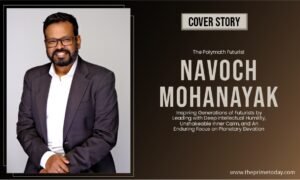
Navoch Mohanayak is a strategist who builds a bridge between the mathematical possibilities of tomorrow and the operational realities that large conglomerates, strategy offices, and policy makers face today. He approaches oncoming computational shifts not with the distant gaze of an academic, but with the sharp focus of an ecosystem architect – a visionary leader, planet evangelist, and lifelong technology first-adopter who ensures groundbreaking innovation serves a practical, human purpose.
In his category-first Deep-Tech venture, quaStrat, working alongside his co-founder, Nameeta Kagvate, Navoch balances bold strategic vision with rigorous execution. Where his mind leaps naturally toward large-scale optimization and quantum timelines, Nameeta anchors the venture in deep execution capability and structured operational logic, while retaining the agility and nimbleness essential for innovation. Together, they have built a partnership that avoids the common trap of deep-tech ventures – turning what could easily become fantasy, into grounded, scalable decision tools that organizations can deploy right now. Equal parts executive champion, globally recognized author on human behavior and material theology, and thoughtful philosopher, Navoch operates on a singular premise: true leadership doesn’t just predict the next era; it patiently designs the plumbing that makes it livable.
The Blueprint of Industrial Execution
Navoch’s journey has always been guided by a fascination with how complex ideas transition from abstract concepts into effective, real-world implementations. He began his career focused entirely on corporate strategy at Honeywell, operating across a massive sandbox of automation solutions, building systems, sensing and control, aerospace and defense, and specialty materials. It was a masterclass in industries and technologies, and it eventually gave him the mandate to lead major portfolios entirely from idea to cash, including driving a mobile-native residential security portfolio all the way to global commercialization. That early crucible proved invaluable: it taught him that a product doesn’t succeed merely because its underlying engineering is sophisticated; it succeeds because the entire architecture has been meticulously synchronized with user trust and market readiness.
The Mechanics of Media Transformation
Following this foundation, Navoch joined Frost & Sullivan as one of the initial members of the strategy consulting team, where he was heavily responsible for the firm’s early advisory scale-up. Seeking a radical challenge, he took an in-between stint to join the strategy team at Star TV (now Disney Star). That chapter was a massive lesson in media-scale translation. His focus was on driving the introduction of technology and deep analytics into core content and distribution decision-making. By leveraging behavioral data, they fundamentally changed the way India watches television, shifting the entire paradigm from traditional, static broadcasting schedules to a highly dynamic, data-responsive medium where massive content and delivery innovations naturally stemmed from that original, foundational overhaul.
The Macroscopic View of Growth
Navoch’s last corporate employment brought him back to Frost & Sullivan, where he took the reins to lead the strategy and implementation advisory team for the South Asia and Middle East regions. Leading that practice across such diverse, high-growth, and politically complex geographies allowed him to look at systemic growth on a truly macroscopic scale. It was during this tenure that he championed the Mega Trends work, and was an architect of the MetaBrain initiative, a strategic project designed to map complex, multi-variable environments. Beyond specific initiatives, he became known across the region as the person who could model seemingly impossible, chaotic problems into workable hypotheses and structured mathematics. He developed a reputation for taking on strategic challenges that the market deemed insurmountable, purely by stripping away the noise and finding the elegant mathematical logic hidden underneath.
The Velocity of Innovation
Today, this journey has culminated in Navoch’s current role as the Co-founder and Chief Executive Officer (CEO) of quaStrat. Navoch and Nameeta have built quaStrat to be a lean, highly mature advisory company that deliberately retains the agile, fast-moving soul of a startup. They don’t suffer from the bureaucratic bloat that slows down legacy consulting firms; instead, they operate with maximum execution speed while possessing the institutional depth required to handle enterprise-grade complexity. They move fast, stress-test models relentlessly, and pivot fluidly, allowing them to serve as a high-velocity innovation partner for entities facing immense computational and strategic shifts.
Navoch’s path toward leadership was shaped in large part by his upbringing. Being raised by academician parents specializing in physics and computer science, he internalized a deeply analytical, first-principles way of looking at the world. He grew up seeing incredible scientific concepts debated in clean, quiet rooms, but he often noticed a massive gap between those brilliant concepts and their practical, societal application. He realized early on that true leadership is the art of translation, it is the process of taking complex, intimidating technical capabilities and building the human, operational frameworks required to make them useful.
The Convergence of Complex Horizons
What motivates Navoch today is the realization that they are rapidly approaching a massive convergence. Quantum math is going to become a vital part of their everyday computational decision-making support, and it is happening much faster than most organizations realize. This pursuit has also allowed him to express his core philosophies beyond the boardroom. As a published author, seeing his books on human behavior, cultural observations, and material theology recognized across multiple global platforms has shown him that the hunger for understanding human behavior and societal constructs is truly universal. Helping large corporate strategy offices, conglomerates, and policy makers navigate this oncoming computational shift keeps him intensely focused. The challenge of building the cognitive and physical scaffolding to support that paradigm shift is an intoxicating problem that keeps Navoch moving forward every single day.
The Synergy of Strategic Empathy
Navoch’s leadership philosophy centers on Strategic Empathy and Absolute Clarity. He doesn’t believe in managing people through rigid, bureaucratic task lists. Instead, he believes in aligning teams around a shared, deeply understood purpose and then giving them the space to innovate. Because they operate in highly complex fields, he views his primary role as creating a safe, open environment where team members can voice doubts, challenge assumptions, and air out ideas without the fear of looking foolish. This is where the balance between Nameeta and himself becomes a core part of their management style at quaStrat.
Navoch brings the long-term vision and macro-strategy, while Nameeta infuses the team with structured execution, operational discipline, and deep empathy. They ensure that their people are not burning out in pursuit of an abstract ideal, but are instead growing within a highly sustainable, collaborative framework. They encourage their teams to look at failures not as setbacks, but as essential learning data. By coupling high intellectual benchmarks with a deeply human, supportive culture, they cultivate true operational excellence.
The Narrative of Human Connection
Driving innovation isn’t about deploying a complicated technical manual or forcing people to memorize corporate buzzwords, feels Navoch. It is entirely about human connection, simple language, and meaningful storytelling. As a leader, his primary tool for transformation is contextual storytelling. If he wants a team to build a completely new kind of computational support system, he doesn’t just hand them a list of technical requirements. He tells them a story about the end user – the corporate strategist or the policy maker sitting in a room at 2 AM, trying to make a critical resource decision with completely broken data – and getting stuck in loops that seem unbreakable. By painting a vivid picture of the real-world friction they are trying to erase, abstract math suddenly becomes a tangible, human mission.
The Permission to Fail
Secondly, Navoch believes in driving innovation by actively giving his teams a license to make mistakes. In many companies, people are terrified of failing because they worry about their performance reviews or their standing in the organization. That fear kills creativity instantly. He tells his team, “Go push this model until it breaks, and then let’s figure out why it broke together.” He acts as a buffer, shielding them from outside pressure so they can experiment freely. When you remove the penalty for a wrong turn and treat every mistake as a useful data point, transformation happens naturally. Innovation thrives when people feel safe enough to try something completely unconventional.
The Lesson of Over-Ambition
As a leader, the most transformational challenge Navoch has faced was overcoming his own professional over-ambition. A few years ago, fresh off developing complex strategic frameworks, he fell into a trap that catches many deep-tech leaders: he tried to solve massive, economy-wide resource allocation problems all at once using pure quantum models. It was an incredibly elegant piece of theoretical work. Still, the moment it collided with the messy, noisy realities of real-world enterprise data and existing classical hardware, the entire system choked. That experience was an incredibly humbling lesson in commercial detachment. It taught him that enterprise buyers and policy makers don’t buy physics papers; they buy predictability and reliability. If a model is too complex to execute on warm silicon today, it is a non-commercializable fantasy.
The Grounding of Strategy
This realization is what led to the pivot that defined quaStrat. It is also why having Nameeta as a co-founder is so vital to his leadership journey. Her operational guardrails and sharp market focus ensure that they never wander back into that territory of unexecutable over-engineering. They now ensure that their strategy to remain grounded in what is buildable, testable, and commercially viable next quarter, not next decade. A culture of growth is fostered by modeling humility from the top down. Navoch makes it a point to openly discuss his past prototype failures and the moments where his macro-models collapsed under real-world data pressure. When a leader admits their limitations, it breaks down the walls of corporate pretense. It allows a junior data scientist or an operations manager to step up and say, “This strategy looks brilliant, but the real-world execution is going to run into an unexpected bottleneck here.”
The Focus on Personal Development
Furthermore, they place a massive emphasis on conscious personal development. “We explicitly teach our teams that while the work they do is incredibly important, it cannot come at the cost of their inner peace,” informs Navoch. They actively encourage their people to learn how to consciously disconnect, step away from the screens, and quiet their minds. In a hyper-paced field like deep tech, a team that doesn’t know how to rest will eventually lose its edge. They cultivate excellence by ensuring their people are as disciplined about their recovery and mental calm as they are about their code and strategy sessions.
The Quantum Paradigm Shift
Technology is reshaping the future of business across all industries faster than the industry participants are currently prepared for. They are moving into an era populated by highly intelligent machines and augmented, technology-modified humans, creating a completely unprecedented data landscape. The speed of this disruption is leaving traditional leadership frameworks completely flat-footed. In this new paradigm, quantum computing is not just a faster processor; it is an entirely different way of engaging with reality. Quantum’s true power lies in its unique ability to operate effectively within a design that classical systems define as absolute chaos. It is the only system that can closely match the complex, hyper-dimensional neural pathways of the human brain. Because it mirrors that organic structure, quantum architecture is creative enough to predict, understand, and handle massive macro-environmental changes in ways that are yet not known to modern data science. It will be the foundational infrastructure required to navigate a world where traditional linear logic no longer applies.
The Horizon of Macro-Trends
Staying ahead of the industry trends requires operating as a dedicated AI super user and a passionate technology first-adopter. Navoch doesn’t look at technology as an external tool to be reviewed; he immerses himself natively in emerging digital frameworks the moment they surface. This allowed him to look at slow-moving, fundamental macro-currents of our planet rather than the frantic daily news cycles of the tech world, mapping trends through the lens of a planet evangelist. “For instance, when looking at the future of sustainability, it’s clear that our climate is already past the point of simple preventative care; it is irreversibly damaged, meaning that comprehensive climate control and adaptive geo-engineering will eventually become an accepted global norm.” Quantum-backed modeling will play an enormous role in making that painful transition smooth for global populations.
The Landscape of Long-Term Realities
Similarly, automated waste management is poised to become a massive lever in maintaining socio-political balance across developing nations, Navoch adds. In the energy sector, while solar and solar hybrids will provide vital local power, controlled cold fusion will inevitably step in to handle the heavy lifting of baseline global power generation, with hydrogen acting as the only truly viable, quick-refill fuel for heavy logistics and heavy industry. By mapping their strategy to these inevitable long-term realities, quaStrat stays years ahead of standard market demands.
Balancing business growth with long-term sustainability requires expanding their definition of sustainability to encompass complete business sustenance – ensuring the long-term resilience, viability, and adaptability of an entire enterprise. Environmental sustainability is a crucial component of this, but true sustenance means building organizations that can survive massive, non-linear market disruptions without breaking down. Traditional corporate strategy often treats longevity and immediate growth as conflicting goals, assuming you must sacrifice long-term safety for short-term revenue. The founders at quaStrat reject that premise entirely.
The Math of Business Sustenance
Through quaStrat’s lean, agile model, they integrate environmental, operational, and capital sustenance into a single unified framework. When they analyze a conglomerate’s strategic path, environmental factors like carbon risk and resource depletion are calculated alongside market volatility, supply chain security, and capital efficiency. “We show leaders that minimizing ecological waste, protecting energy access through solar hybrids or hydrogen models, and building highly adaptable decision paths are mathematically identical to preserving capital.” Business sustenance is achieved when an organization is designed from the baseline math up to be resilient enough to withstand ecological shocks, technological disruptions, and geopolitical shifts simultaneously.
The Trait of the Technical Translator
To aspiring professionals who want to become successful business leaders, Navoch’s most urgent advice is to avoid the comfortable trap of becoming a narrow, one-dimensional specialist. The world is changing too quickly for rigid career lanes. It is no longer enough to be a pure technologist who doesn’t understand a profit-and-loss statement, nor is it viable to be a corporate executive who treats advanced computation or quantum physics like an isolated IT ticket. The future belongs entirely to the translators – the rare individuals who can sit comfortably in a room full of deep-tech engineers, deeply understand the underlying science, and then walk into a boardroom and translate that complexity into clear commercial execution and human value. To build that capability, you must actively seek out the messiest, most chaotic integration problems early in your career. Do not run away from operational messes; run toward them. It is in those high-friction environments where you learn how systems actually break and how diverse teams actually communicate.
The Power of Inner Quiet
But far beyond acquiring technical or strategic skills, Navoch’s deepest advice centers on the cultivation of personal character and mental discipline. Do not let the intense velocity and constant noise of the corporate world consume your inner quiet. There is absolutely nothing better than staying calm for effective decision-making by leaders. When a massive strategic crisis hits, your team will not look to you for frantic, hyperactive energy; they will look for a steady, grounded, and unshakeable presence. If your mind is constantly racing, you will miss the subtle, non-linear signals that dictate success or failure. You must build the habit of slowing down, learning to consciously disconnect from the digital grid, and fiercely protecting your inner peace. Cultivating a quiet, still mind is not a soft wellness practice – it is the ultimate, hard-edged competitive advantage for any leader steering an enterprise through total uncertainty.
The Milestones of Transformation
From a corporate perspective, Navoch is incredibly proud of the systemic transformation they achieved at Star. Helping shift an entire nation’s media consumption habits by introducing deep analytics into an industry that previously relied entirely on creative intuition was a massive, uphill battle. Seeing how that work laid the structural groundwork for an entire ecosystem of content and digital innovations – transforming television from a one-way broadcast into a responsive consumer experience – remains a highlight of his career.
Navoch is equally proud of his time heading the strategy and implementation advisory practice at Frost & Sullivan across South Asia and the Middle East. Building a cross-border reputation as the strategist who could step into an absolute operational mess, break down insurmountable challenges, and model them into clean, workable mathematical hypotheses was incredibly rewarding. Over the course of this journey, he has had the privilege of building deeply trusted, excellent client relationships with some of the greatest brands and largest conglomerates in the world. Being the advisor that global business leaders call when their systems freeze, and their traditional strategies fail – and successfully guiding those legendary institutions through complex corporate transformations – is a professional achievement that he carries with immense pride.
The Vision for Indispensable Intelligence
Looking ahead, Navoch’s vision for quaStrat is to see it become an indispensable global architect of decision intelligence. They are actively working toward a future where they can help establish ‘Quantum White Spaces’ – collaborative, public-private sandboxes where early-stage deep-tech startups can build practical application layers directly on top of stable, software-defined quantum control layers, connecting them safely with corporate early adopters and policy implementation agencies.
On a broader industry level, their vision must extend past our immediate planetary limits. Humanity is rapidly expanding its horizon; space is no longer a distant destination, it is already our home. Within our lifetimes, hyper-space travel and complex off-world resource logistics will transition from theoretical physics into active engineering realities. To support an interstellar, highly integrated civilization operating alongside intelligent machines, their industry must move entirely away from slow, batch-processed data models. We must build continuous, rolling-horizon decision support systems that allow humanity to navigate macro-complexities with grace and precision.
The Legacy of Upgraded Infrastructure
Finally, the legacy Navoch wishes to leave behind is a fundamentally upgraded, deeply humane global Decision Infrastructure. He wants to look back a few decades from now and know that through their advisory frameworks, his international literary contributions on human culture and material theology, and their ecosystem sandboxes, they helped demystify the quantum transition – turning an intimidating mathematical frontier into a reliable tool that helps humanity solve its most agonizing resource, energy, and climate complexities. But on a deeper, quieter level, he wants this legacy to prove that true strategic greatness doesn’t require constant, frantic noise.
Navoch wants to show aspiring leaders that a quiet mind is the ultimate competitive advantage and that they can step up to insurmountable challenges with absolute stillness. “If we can inspire a generation of futurists, corporate strategy offices, and policy makers to lead with deep intellectual humility, unshakeable inner calm, and an enduring focus on planetary elevation, then we will have left the world a far more stable, conscious place than we found it.”