India Water Reserves at 10-Year Low as Storage Falls to 70%
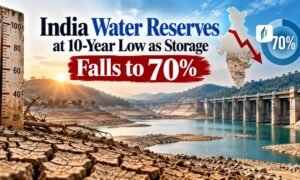
India’s water storage has fallen to a 10-year low in India water reserves, with levels in 178 key reservoirs reaching 70% of their combined capacity ahead of the southwest monsoon’s scheduled end on September 30. The figures come from the Central Water Commission’s live reservoir storage report dated September 24.
The current level is below the 10-year average of 76.62% for the same period and also trails the 79% recorded in 2025. The decline comes as parts of the country face concerns over water availability and rainfall patterns.
The India water storage level for 2026 has drawn attention because the national figure masks sharper declines in some regions. The CWC report identified particularly low storage across 92 reservoirs in southern, eastern and northern parts of the country.
South India has recorded the lowest reserves among the regions mentioned in the report. The five states of Andhra Pradesh, Telangana, Karnataka, Kerala and Tamil Nadu have combined storage at 50%, equivalent to 27.926 billion cubic metres.
The region’s current level is considerably lower than the 87.25% recorded during the same period last year. India Meteorological Department data cited in the report shows South India received 23% below-normal rainfall as of September 28.
The India water reserves data comes as Maharashtra and Karnataka have declared drought conditions, adding to concerns about water availability in affected areas.
The reservoir figures are particularly important because these storage systems support drinking water supplies, irrigation and other needs. However, the supplied report does not provide a state-by-state breakdown of all 178 reservoirs, so the national figure alone does not show how storage conditions vary across individual states.
The gap between the current level and the decadal average also indicates that reservoir storage has not kept pace with the typical level recorded at this point in the monsoon cycle.