Mumbai-Ahmedabad Bullet Train Track Change at High Speed Explained
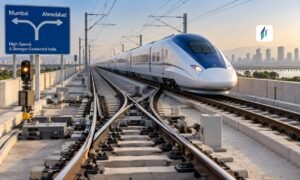
The Mumbai-Ahmedabad bullet train track change system is designed to allow trains to move between tracks while operating at speeds of up to 320 kmph. The National High Speed Rail Corporation Limited (NHSRCL) is using specialised technology to handle track switching without compromising the precision required for high-speed rail.
The 508-km Mumbai-Ahmedabad High Speed Rail corridor has a design speed of 350 kmph and an operational speed of 320 kmph. The first operational section is being developed as part of the phased rollout of the project.
On conventional railway lines, trains change tracks through a turnout, where sections of rail move to guide a train from one track to another. At high speeds, the design has to minimise sudden impacts, vibration and mechanical stress when the train passes through the switching area.
The bullet train track switching system uses two point machines at critical switch locations. These machines provide redundancy by checking that the track components have moved into the required position before the train is allowed to pass.
The two-machine arrangement is particularly important for safety. If the system detects that the switch has not reached the correct position or that a machine has malfunctioned, the train movement can be stopped and an error can be indicated instead of allowing the train to enter an incorrectly aligned route.
The Mumbai-Ahmedabad bullet train track change system is therefore not simply a faster version of an ordinary railway turnout. It combines precise mechanical movement with monitoring systems designed specifically for high-speed operations.
The corridor is also being equipped with other safety technologies. NHSRCL is installing 28 seismometers along the alignment and in earthquake-prone areas of Maharashtra and Gujarat. If significant seismic activity is detected, the system can shut down power in the affected section, allowing trains to initiate emergency braking.
The bullet train track switching system will form part of the wider signalling and railway infrastructure being tested as construction progresses. The first passenger services are planned in stages rather than opening the entire Mumbai-Ahmedabad corridor at once.
The project’s high-speed systems will need extensive testing before regular operations begin. Track switching, signalling, electrification and emergency systems will all have to work together to safely handle trains travelling at 320 kmph.