The Divine Descent and the Prophesied Legend of the Great Kalki Avatar 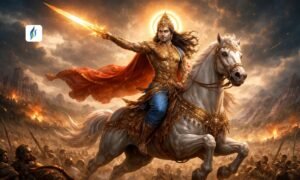
The Divine Descent and the Prophesied Legend of the Great Kalki Avatar
Time in old Eastern thought turns like seasons, looping through grand ages called Yugas. Near the height of this dark phase, eyes turn ahead, waiting for a sign of deep renewal. In that structure of endless return, Kalki appears as the closing shift of all things. Not just a fighter on horseback, yet something deeper – required when trust, duty, honor – all dissolve into noise. When goodness vanishes and disorder fills every corner, balance demands a response: existence winds back, then breathes anew. A fresh span of clarity begins only after the storm passes.
The Tenth Avatar and Its Prophecies
Out of all the ancient stories about gods stepping into our world, one stands apart because it shows up last – when everything has nearly fallen apart. Right at the edge of time, when darkness thickens, comes Kalki, said to arrive as the Kali Yuga fades away. Some texts, like the Agni and Vishnu Puranas, place his birth in a quiet village hidden far off – Shambhala by name. While earlier forms fought single enemies in small corners of land, this one carries work meant for the whole earth. A bright sword cuts through myths here, glowing fierce as a falling star. He rides a pale horse called Devadatta, galloping not for war alone but for resetting what went wrong deep inside people.
When things inside people start showing clear warning signs, the Kalki avatar draws near. Power in leaders turns cruel instead of fair, while inner awareness fades like a dying flame. Ancient writings point out how nature follows suit – rivers run low, crops fail, weather forgets its rhythm. Amidst such widespread breakdown, something sacred steps in – not to punish, but to trigger deep unraveling. That moment, called Mahapralaya, strips away illusion with precision, clearing space where true growth was once blocked.
Symbolism of the White Horse and the Flaming Sword
To understand the depth of the Kalki avatar, one must look past the literal martial imagery and into the esoteric symbolism. The white horse is widely interpreted by scholars as a representation of speed, purity, and the untamed power of the cosmic mind. It signifies that the transition between the old world and the new will occur with lightning-fast precision. Similarly, the flaming sword held by the Kalki avatar represents “Jnana” or transcendental knowledge. This weapon does not cut through flesh but through the thick veils of illusion that keep people trapped in a cycle of suffering and materialism.
Furthermore, the legend suggests that the Kalki avatar will be trained by immortals who have walked the earth for millennia. This connection to the “Chiranjeevis” links the final incarnation to the entire history of the world’s spiritual evolution. The presence of such teachers indicates that the final transformation is a coordinated effort of cosmic proportions. By synthesizing the wisdom of the past with the power of the present, the savior cleanses the collective consciousness of the planet. This prepares the ground for the Satya Yuga, a golden age where humanity naturally lives in alignment with the laws of the universe.
The Socio-Cultural Impact of the Final Prophecy
Throughout history, the narrative of the Kalki avatar has provided a sense of hope and a framework for understanding social decline. In times of extreme hardship or political upheaval, the promise of a divine corrector offers a psychological refuge for those seeking justice. This prophecy encourages a long-term view of history, reminding followers that even the darkest periods are temporary. The influence of the Kalki avatar extends beyond formal religion, permeating art, literature, and modern media, where the trope of the “chosen one” who arrives at the brink of apocalypse continues to resonate deeply with global audiences.
The expectation of the Kalki avatar also serves as a moral mirror. It forces individuals to examine their own role in the current age. If the end of the cycle is characterized by a loss of integrity, then the pursuit of individual virtue becomes a form of resistance against the encroaching darkness. While the physical appearance of the deity is a future event, the spiritual essence of the message is immediate. It calls for a “Kalki-like” clarity in one’s own life—the ability to distinguish between truth and falsehood and the courage to stand for what is right when society chooses the easier path of compromise.
Anticipating the Dawn of the Golden Age
As we contemplate the role of the Kalki avatar, the focus eventually shifts from the act of destruction to the beauty of the subsequent rebirth. The conclusion of the Kali Yuga is not a permanent end but a transition. The legend holds that once the world is purged of its accumulated negativity, the souls that remain will be those of exceptional purity. These individuals will become the seeds of the next Satya Yuga. Therefore, the Kalki avatar is fundamentally a figure of renewal. The heavy clouds of the current age are swept away to reveal a sun that has never truly set, only been obscured by the debris of human greed.
The transition period is described as a time of immense spiritual acceleration. For those who are prepared, the energy of the Kalki avatar provides the momentum needed to transcend ordinary limitations. It is a reminder that the universe is self-correcting and that harmony is the ultimate destination of all living things. By looking forward to this divine intervention, humanity is invited to look inward and find the spark of divinity that remains untouched by the chaos of the external world. The legend remains a powerful testament to the belief that light will always return to conquer the shadows.
Read Also: Understanding the Global Climate Impact of What is El Nino and How It Works